Posted By Ken April 4, 2011
Finally, someone respected in tax-fighting circles points out something thoughtful about efforts to repeal the Volumetric Ethanol Excise Tax Credit (aka VEETC): Doing so represents a tax increase. You can read the New York Times story here.
Tax fighter Grover Norquist may not like VEETC or even ethanol, but his argument is an important one that should be followed by those politicians who took a “no new taxes” pledge like the Taxpayer Protection Pledge sponsored by Americans for Tax Reform, Norquist’s organization.
In a letter to Senator Tom Coburn of Oklahoma, disputing with the senator about his proposed VEETC repeal, Norquist notes that the ethanol credit “is not a spending program, despite your repeated attempts to claim that it is. According to the Joint Tax Committee (JCX-54-10), your amendment would increase taxes by $4.869 billion over the next two years. Repealing the ethanol credit is the right thing to do, but other taxes must be reduced in the same legislation by at least this much to prevent a net tax increase.”
Further:
“Spending programs and tax relief are not the same thing. If the government lets Tom Coburn keep a dollar of his own money, that is not the same thing as the government stealing a dollar from Ryan Ellis and giving it to Tom Coburn. The differences between tax relief and spending are unambiguous.”
4/5/11 Update:
The editorial writers at the Wall Street Journal, which in their zeal to kill the ethanol industry do not care about the means involved in doing so … or the scope of collateral damage … or consistency with supposed free market principles … have published an editorial on this subject today, taking Sen. Coburn’s side, of course.
Posted By Cindy April 4, 2011
The secretary of agriculture has one of the toughest jobs in the administration. Despite the title, direct support to agriculture is only a small part of the USDA, but it has everything to do with the rest of it. Maybe a better title would be Secretary of Food, Farming, Feed, Fuel, Fiber and Forestry so that Americans are more aware of how agriculture touches every aspect of their lives.
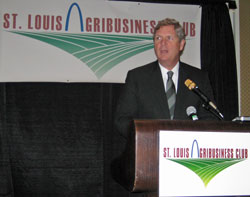 Last week, U. S. Secretary of Agriculture Tom Vilsack made a visit to St. Louis where he was the keynote speaker at the St. Louis Agribusiness Club meeting. Noting that 44% of the nation’s agricultural production is located within a 500 mile radius of St. Louis, including 75% of the nation’s corn and soybeans, the secretary focused his remarks the importance of agriculture to the country as a whole.
“It has to do with the value system of this country,” he said. “Virtually everyone who started this country was a farmer and virtually every single founding father came from a rural background. And here’s what they knew and here’s what every farm and ranch family has passed on from generation to generation - and that is that you cannot keep taking from the land. It’s a basic understanding of agriculture.”
Vilsack said that philosophy of giving back has carried over to the young people of rural America. “That’s why 16% of the population of the country lives in rural America but 44% of our military comes from rural America,” he noted.
Vilsack stresses the importance of agriculture and rural America to those in Washington DC, but he says it is critical for those in agriculture to stick together when they represent less than one percent of the population. “There aren’t enough of us to be fussing with each other. We have got to have a single voice about the important role that agriculture plays in the life of every single American.”
You can listen to or download the Secretary’s Comments here: Secretary Vilsack's Remarks
Posted By Mark March 18, 2011
Originally printed in the Bristol Herald Courier - Written by Nate Hubbard:
http://www2.tricities.com/sports/2011/mar/18/nascars-transition-new-e15-fuel-going-smoothly-ar-913499/
Not even five-time Sprint Cup champion Jimmie Johnson will be able to best a new entrant on the NASCAR scene this season.
The winning car each week on the three national NASCAR circuits in 2011 will be powered by American-produced ethanol.
“We’re guaranteed a spot on Victory Lane in every race,” said Darrin Ihnen, a farmer from Hurley, S.D., and the chairman of the National Corn Growers Association, one of the many groups behind NASCAR’s new six-year partnership that is putting a literally home-grown fuel into its vehicles.
The new fuel – Sunoco Green E15 – is NASCAR’s answer to its environmental critics – and ethanol’s answer to its own doubters about the fuel’s capabilities.
“If their product can withstand a duration of a Sprint Cup race … it can certainly last in your daily drive,” said Cup driver Clint Bowyer, whose No. 33 car will have American Ethanol as its main sponsor for one race later in the year. “That’s putting it to the test in a NASCAR.”
Sunoco Green E15 is a mix of unleaded gasoline and 15-percent ethanol produced by corn grown in the United States. Once the corn is harvested, it is processed into grain ethanol and then refined and blended at a Sunoco facility in Marcus Hook, Pa.
NASCAR will use approximately 450,000 gallons of the fuel throughout the year as every car and truck in its three national series will chase the checkered flag while running on the mixture.
While Bowyer said the ethanol blend, which has a higher octane than pure unleaded gasoline, has helped boost the cars’ horsepower, he said the mark of its success so far in the young season has been its inconspicuousness.
“It’s such a good product that it kind of goes under the radar,” he said.
Bowyer grew up in Emporia, Kan., a small community in the heart of America’s heartland. He said supporting a product that supports rural farmers fits in well with his background.
“That’s where we’re from, that’s what we do,” Bowyer said. “… It’s a good tie for me. It’s something that I was proud of right off the bat.”
While many of Bowyer’s backers may already be proponents – or even producers – of ethanol, Ihnen said NASCAR’s strong influence in the South gives the fuel a chance to gain a foothold in a new region.
“We think it’s an opportunity to get the true message out [about ethanol] to a very patriotic group of fans that are typically outside the Midwest,” Ihnen said.
As a component of its partnership, for which financial terms were not disclosed, the American Ethanol name and logo are on the green flag waved at each race. The group’s green stamp also surrounds the fuel port on each NASCAR vehicle.
In addition to serving as the major sponsor on Bowyer’s car for a future race, American Ethanol is also a secondary sponsor on his car all season.
Ethanol producers had long had wanted to join forces with NASCAR, said Tom Buis, CEO of Growth Energy, which promotes the use of ethanol and helped cement the new partnership.
“In my opinion there’s no sport more American than NASCAR and there’s no more American fuel than ethanol,” he said.
Ethanol’s new presence in NASCAR coincides with its increasing prominence at gas stations around the country. Many pumps now come with stickers saying their fuel may contain 10-percent ethanol and the Environmental Protection Agency earlier this year gave its stamp of approval for the suitability of the E15 blend in all cars manufactured since 2001 – a ruling that will likely lead to the 15 percent mixture becoming more common.
While some critics still question the use of croplands for fuel instead of food in the production of ethanol, Buis said Growth Energy didn’t have to sell NASCAR officials on the green – and performance – benefits of ethanol.
“I think they understood both what it does for America and for their sport,” he said. “They obviously did their homework, extensive testing to see how it would work.”
And so far, so good.
Posted By Guest Blogger March 18, 2011
From NCGA First Vice President Garry Niemeyer, a grower in Auburn, Ill.:
For years, there has been discontent with ethanol policy and it finally came to a head in the Senate this week with Sen. Tom Coburn of Oklahoma proposing to eliminate the Volumetric Ethanol Excise Tax Credit. Now this comes at a very interesting time in our society, when we are facing rapidly rising energy costs and a senator from an oil state making the proposal.
Who would invest in any new energy venture with this type of attitude in our Senate? We have not built a nuclear power plant in over 30 years, coal fired power plants are not acceptable, drilling for oil in the Gulf and elsewhere has been curtailed in many locations due to environmental laws. Given this scenario it critcal that we make development of domestic energy a priority in all its forms. Alternative energy like ethanol is fundamentsl to avoiding an increased dependence on foreign oil. After observing several countries in Northern Africa to Saudi Arabia in social conflict, why would a U.S. senator want to make us more dependent than we currently are, at over 60 percent?
Sen. Coburn’s need to reduce the federal budget may be the excuse he is using to promote his ideas, but let’s look into that budget discussion for a second. Currently, we are spending $4 billion more than we take in on a daily basis. If the total $5.6 billion VEETC were eliminated, that would erase a little over one day’s worth of our budget deficit here in the United States.
Now, I am not sure, but cutting off your nose to spite your face seems a little overreaching and not appropriate. So, Senator, how are you going to resolve the other $1.595 trillion and bring the budget back in line? One could argue that Sen. Coburn, now in his second term in the Senate, is more responsible for our US economic problems than ethanol is.
Cooler heads need to prevail and understand that there are no perfect forms of energy and we do not live in a perfect world. We are going to have to work together to reduce the costs of all forms of energy to resolve our two problems, lack of domestic energy and elimination of all subsidies on all forms of energy on an even basis.
If Sen. Coburn is willing to be known as the senator who made us more dependent on foreign oil, he should rethink where he is taking this country.
Posted By Ken March 16, 2011
A sad story in the St. Louis Post-Dispatch this morning tells how one of the area’s animal shelters was raided and 195 dogs and cats were rescued for the second time in their miserable lives. In today’s economy, donations are down at shelters and more pets are being abandoned and dropped off, creating a bad situation for people who want to help animals.
But at the same time here in Missouri, Proposition B, the so-called “Puppy Mill Cruelty Prevention Act,” which passed by a narrow margin in last year’s election, is under review by a state legislature anxious to take a fresh look and lawmakers are being attacked in the local media. While animal rights activists are calling foul, they are ignoring a simple fact most voters were unaware of … shelters like the one raided are exempt from the new law.
If Proposition B was just simple language all about the welfare of dogs, why did those forces pushing for it last year exempt themselves? If the Missouri legislature cannot dilute or delete Proposition B, perhaps lawmakers should take the opposite approach — try to remove the exemptions and force the shelters to explain why they should not be held to the same scrutiny they impose on others.
Thanks to this morning’s paper, I can think of 195 silent witnesses for the prosecution.
Posted By Ken March 15, 2011
The USDA now tells us that farms and agribusinesses represent less than 12% of each food dollar. When will folks start looking at the other 88% as a possible cause of higher food prices?
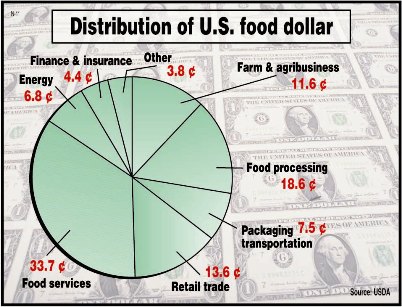
More information here from the USDA.
Posted By Ken March 7, 2011
Chipotle’s newest campaign to make a buck once again serves up an attack on farmers with a phony newspaper filled with self-promotion and at least one glaring error. At the risk of repeating a negative, they significantly downplay the role of family farms in an attempt to perpetuate a make-believe distinction between “family farms” and so-called “factory farms.” Their non-sourced stat provides a much lower number than reality; according to the USDA, family farms of different sizes account for 98 percent of farms and 82 percent of production.
And it really is nice they offer a column called “Ask Chipotle” but they really should provide contact information so we can send in questions.
In the end, this newspaper proves useful – for providing a placemat to soak up all the drippings of their thousand-calorie burrito.
Posted By Ken March 7, 2011
 Farmers and ranchers from across the nation are joining with business, televisions viewers and a broad consortium of agricultural organizations – including the National Corn Growers Association — to launch a new grassroots campaign to support America’s Heartland, the only nationally distributed program on U.S. agriculture, as it seeks production funding for its seventh season. Friends of America’s Heartland has launched a new website asking the grassroots fans of the award-winning series to support it by making donations and encouraging others to do so. The site is already receiving individual donations from fans of the series.
The grassroots effort is drawing praise from many major U.S. commodity groups, who are already promotional partners for America’s Heartland.
“We truly believe there’s no other program on television that does a better job sharing the positive stories of American agriculture with non-farm viewers,” said Bart Schott, President of the National Corn Growers Association. Added Terry Vinduska, Chairman of the U.S. Grains Council, “As longtime supporters of America’s Heartland, we’re delighted there’s a new campaign underway to keep this essential program on the air.”
Lead spokespeople for the grassroots campaign include Chris Chinn, a Missouri hog farm owner and outspoken agriculture advocate. “This show has brought the American farm and ranch into the homes of millions who otherwise would not see how we operate our farms & ranches on a daily basis,” says Chinn. “America’s Heartland puts a face and a voice on agriculture, and it’s the accurate image of how America’s farmers & ranchers are protecting our nation’s food security while meeting the ever growing demand of our world population.”
The Friends campaign will supplement the generous support already promised for Season 7 by the American Farm Bureau Foundation, Farm Credit Services, and the United Soybean Board. Additional major funding support is still being sought. The program has an expanded website and viewers can connect with the show on Facebook, Twitter, and YouTube. America’s Heartland is produced by KVIE Public Television in Sacramento.
Launched in 2005, the award-winning America’s Heartland travels throughout the U.S., introducing non-farm viewers to the men and women who provide the food, fuel, and fiber we use and consume daily. Frequently-appearing segments are targeted specifically to consumers: Off the Shelf looks at food choices we make at the supermarket; Fast Facts About Food reveals the nutritional benefits in many agricultural products; and Harvesting Knowledge explores the rich history of foods we enjoy every day.
America’s Heartland also examines how technology is changing production and how sustainability and environmental issues are becoming increasingly important to producers and consumers. Currently, the series is seen on more than 230 PBS stations covering 62% of the U.S. America’s Heartland also reaches viewers with primetime broadcasts on RFD-TV, the cable and satellite channel celebrating the rural lifestyle. Overall, the series reaches more than 40 million viewers each season.
Posted By Cindy March 4, 2011
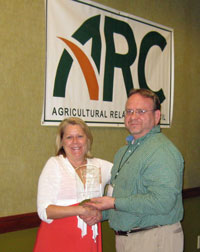 Winners of the Agricultural Relations Council (ARC) 2011 Golden ARC Awards Contest were announced at the association’s annual awards banquet in Ft. Myers on Friday night. A total of 24 Golden ARC winners and 19 Merit winners were recognized as the elite in agricultural public relations. The number of entries this year was twice what it was last year.
In the category of Blogs/Electronic Newsletters category, the winner of the coveted Golden ARC was the National Corn Growers Association and ZimmComm New Media for Corn Commentary. The photo shows me receiving the award from Mace Thornton of the American Farm Bureau Federation, who is president of ARC. The corn growers were also honored with another award in the Print Publications - Single Issue Publications category for “CFC Corn Fact Book” by the Corn Farmers Coalition and David & Associates.
The competition was judged by members of the North Florida chapter of the Public Relations Society of America, according to contest manager Amy Keith McDonald of McDonald Marketing Communications. “The judges focused on a number of objectives including audience analysis, creativity, execution and campaign results,” she said. “They then provided constructive feedback to allow entrants to grow professionally from the opportunity.”
Originated in 1990, the Golden ARC Awards Contest recognizes the best and brightest in agricultural public relations, and is open to both ARC and non-ARC members. The 38 categories reflect the broad scope of contemporary public relations activities.
Find out all the winners in all the categories here.
Posted By Guest Blogger February 25, 2011
In response to an Environmental Working Group article on our CommonGround program, NCGA Corn Board member Pam Johnson sent along this response:
As a woman who sits on the board of the National Corn Growers Association, I am offended by your blog post about our CommonGround program with the United Soybean Board. In your obvious cynicism you ignored that one of the great results of this new program will be the identification, recruitment and training of women to speak out for agriculture – and teaching them key skills that can help them become leaders in their communities and industry organizations. We recognize the need for more women leaders and are taking action and actually doing something about it.
Frankly, I have enjoyed my important role at NCGA, where I am treated with respect as an equal partner in this organization and as I work nationally and internationally on agricultural issues. In addition to my board position, I have served on the NCGA Finance Committee and chaired the Bylaws Committee and previously chaired the NCGA Research and Business Development Action Team. In my home state of Iowa, I am a director of the Iowa Corn Growers Association and former chairwoman of the Iowa Corn Promotion Board. In addition, I am president of Iowa Corn Opportunities and a member of the U.S. Grains Council Biotech A-Team.
In the end, it is naïve and simplistic to look at the number of board members who happen to be female and say women have no power. But if you are going to play with numbers like that, you may be interested to know that at NCGA, one of the three chief executive officers in our recent history was a woman. That’s 33% of our CEOs. Likewise in your focus on how organic agriculture is controlled by women, you conveniently ignored that women also helm the National Association of Wheat Growers and the Corn Refiners Association. And when it comes to our state corn associations, several are run by women – South Dakota, Michigan, Kentucky, Virginia, Maryland, South Carolina and North Carolina.
Farm women work hard alongside farm men, and we need to stop focusing so much on these divides between men and women, large and small farms, and conventional and organic agriculture. We all have more than enough challenges in what we do. The level of cynicism and disdain for the farm women of CommonGround expressed in your post does nothing to help anyone.
Pam Johnson, Floyd, Iowa

