Corn Commentary

Thank a Farmer Video Contest

Farmers MatterAs we near the Thanksgiving holiday it’s time to think about thanking U. S. farmers who feed us. Corn Commentary is now interlinked with the new NCGA/state affiliates website called Farmers Matter.

The website was created to thank farmers and help educate consumers about growers’ dedication for producing the safest, most abundant food and feed supply on Earth, while also supplying the demands for cleaner-burning, renewable ethanol. The site highlights interesting facts about farming, offers an interactive timeline, videos, downloadable badges for placement on blogs or social networking sites, and a video contest designed to thank farmers for their efforts. Prizes totaling $2,500 will be awarded to a first and second place winner.

“Earlier this year the media was full of stories about a pending corn shortage and the impact higher corn prices were having on the consumer’s pocketbook. In the midst of the largest corn harvest in history, we wanted to take a moment to thank our nation’s corn growers for stepping up to meet demands for both our food and feed needs, as well as helping our nation become more energy independent,” says Ron Litterer, NCGA president.

Consumers, farmers and those in agribusiness are encouraged to visit the site, participate in the video contest, comment in the corn commentary discussion forum and use the Forward to a Friend icon to share the site and fun facts about agriculture with friends and family.

Introducing the Buckeye Renewable Fuels Association

Map of Ohio Ethanol PlantsThe NCGA is a sponsor of the Cellulosic Ethanol Summit which concludes today in Washington, DC. I was on hand and learned a lot about where things stand when it comes to a new process to make ethanol.

While there I ran into Mike Wagner who has long been a leader in the corn industry, most recently with the Ohio Corn Growers. He says that there will soon be a number of ethanol plants in operation in Ohio. To help them and the biodiesel industry as well, he’s formed a new group called the Buckeye Renewable Fuels Association. Mike says the Ohio Corn Growers are playing a key role in the development of this organization.

Mike and I sat down to talk about BRFA. He says they’re just getting started and that there was a real need for an organization like this. BRFA will work on regulatory, legislative, promotional and educational issues of behalf of the industry. He says they’ve got 5 ethanol plants coming on line in the next 90 days with 2 or 3 more soon after that. Right now he encourages anyone wanting more information to contact the Ohio Corn Growers office. The new organization will hold it’s first board meeting later this year.

You can listen to my interview with Mike here:

South Dakota’s Kernels of Truth

Kernals of TruthThe South Dakota Corn Utilization Council has started a program called “Kernels of Truth.” Here’s what it’s all about:

Kernels of Truth: Learn more about the facts behind food, fuel and farming in South Dakota. Prices at the grocery store are higher. But the truth is, corn prices have little effect on the retail price of food. Find out more about the costs associated with food production and why our leadership in ethanol production and dried distillers grains is a major reason why livestock producers across the state have a plentiful and economical source of feed. That helps keep food prices lower, not higher. Really.

The program got the attention of the Associated Press and their story was picked up by Forbes.com. On the SDCU website they’ve got a number of resources which can be used to help spread a few kernels of truth.

Why WRDA?

Despite a looming veto threat, the U.S. Senate overwhelmingly passed the Water Resources Development Act (WRDA) conference report Monday evening by a vote of 81-12, making a WRDA victory within grasp.

National Corn Growers Association (NCGA)
President Ken McCauley says “It’s unfortunate the administration is threatening veto. Our infrastructure cannot keep pace with demands and is falling apart. We must upgrade the lock system on the Upper Mississippi and Illinois rivers to compete in the global market place. Our hope is the president will take seriously his responsibility to ensure our nation has a safe and viable infrastructure by signing WRDA into law. Ignoring that responsibility is a dangerous gamble.”

Miss River LockNCGA says a presidential veto will only delay passage of the bill as there is strong congressional support for WRDA and a veto override is likely.

Corn growers nationwide have been long-time advocates for improvements to our inland system. WRDA provides authorization for seven 1,200 foot locks on the Upper Mississippi and Illinois rivers. WRDA is crucial to farmers who depend on the inland waterway system to deliver their crops to the global marketplace and to businesses who rely on the system to move their raw materials and products.

According to Missouri Corn Growers Association president Mike Geske, “The Mississippi River transportation system is key to both exports and imports. We need access to grain and livestock markets around the world, but our cities and towns also need the ability to import basic commodities like steel, building materials and petroleum products.”

It is estimated that 60 percent of U.S. grain exports are transported via the Mississippi River. The construction of seven new locks will help speed barge traffic, allowing farmers and businesses greater access to global markets.

“Countries around the world are upgrading their transportation systems to compete in the international marketplace,” summarizes Geske. “Without these upgrades, the U.S. will not be able to maintain a competitive edge with markets across the globe.”

Iowa Corn Recognizes Corn Month

Iowa Corn Promotion BoardThe Iowa Corn Promotion Board is recognizing September as Corn Month by issuing several news releases. They’re reminding consumers about the economic importance of Iowa corn and the many products that use corn.

Here’s an excerpt from their first release titled, “The Straight Story: Iowa’s Corn Crop Delivers Food, Feed, and Fuel.”

Iowa corn growers harvest nearly two billion bushels of corn each year, or about seven percent of the world’s total production. With increased demand for corn, Iowans have planted 13 percent more acres of corn this year. That crop is then transformed into livestock products that put protein on the world’s dinner plates, ethanol that fuels more cars and thousands of other essential ingredients and products. Corn is used in more than 4,000 food and non-food products and Iowa’s farm sector supplies nearly $15 billion to the state economy each year.

The Iowa Corn Promotion Board (ICPB) believes that agriculture will continue to meet the nation’s growing demand for both food and fuel. In addition to farmers planting more corn acres, new studies shatter the myths about the relationship between the price of corn, ethanol production and food prices.

Another View of Food vs. Fuel

Illinois Corn GrowersA commentary from the Illinois Corn Growers earlier this week points to an interesting piece on Cattle Network titled, “Jolley: Five Minutes With Terry, Francl, American Farm Bureau Federation.”

Here’s how IL Corn starts it out:

The price of a bushel of corn and its effect on the price of just about everything else has created more nonsense on both sides of the argument than anything since Walt Disney was a pup. Is it a food vs. fuel proposition? Does converting corn to ethanol so we can feed the gas tanks of America steal food from starving Africans? Maybe shipping cheap corn to Chad actually prevents that nation from developing an Ag base that can grow its own food. (So begins a story and interview on “The Cattle Network” website today.

Check it out and see what you think!

Popcorn Poppycock

Iowa PopcornI know Chuck already did a post on the Iowa “Popcorn Propaganda” event, but here are my thoughts to add, along with another picture.

This is Iowa Corn Promotion Board intern Paul Brees with the fruits of his six hours of labor – 38.5 pounds of popcorn. The purpose of Paul’s popping project was to point out to the press and the public that pinning popcorn prices on ethanol production is pure poppycock.

The Iowa photo-op did generate some publicity. The Associated Press story headline reads, “Ethanol Makers Join Food vs. Fuel Debate.” The story was good, the facts were right, the ending comments from the Jolly Time popcorn people fell pretty flat, but the headline was all wrong. It makes it sound like all of the sudden the corn and ethanol industries woke up and decided to defend themselves. The media just hasn’t been listening.

Here is a link to the popcorn facts sheet from the Iowa Renewable Fuels Association that provides some points for the media to ponder. Among them … that tub of popcorn at the movie theater contains .15 pounds, or 2.4 ounces, of popcorn kernels prior to popping. And that five dollars worth of popcorn from the farmer filling all those trash bags would translate to about $1280 at the movie theater.

By the way, in case you were wondering what happened to all that popcorn, Mindy Williamson with Iowa Corn says they donated it to local daycares and two homeless shelters. Not bad for a $5 investment!

Popcorn Propaganda Popped in Iowa

A state corn growers organization decided to use a picture to make a point on how out of control the food vs. fuel debate is getting. The The Iowa Corn Promotion Board (ICPB) and the Iowa Renewable Fuels Association (IRFA) got together for a joint press conference and photo-op to dispel claims that ethanol and higher field corn prices result in higher popcorn prices for moviegoers. The “Popping the Popcorn Propaganda” event clearly illustrated this point by displaying what $5 will buy you at a movie theater versus $5 from a farmer.

Here’s the details from their event:

“The ‘blame ethanol’ game has gotten completely out of control,” stated IRFA Executive Director Monte Shaw. “From a consumer standpoint, for $5 you can buy 1 tub of popcorn at a movie theater or 38.5 pounds of popcorn from a farmer, which, when popped fills nearly a dozen 33-gallon trash bags.
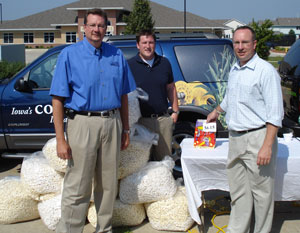
IA Popcorn“From a farm standpoint, in 2006 the farmer received about 1.4 cents for the corn in that $5 tub at the movie theater. In 2007, that same farmer will receive about 2 cents to fill that tub. How can an increase of 0.6 cents to the farmer justify a price hike to movie goers or crazy headlines in the news media?”

To illustrate the point, IRFA intern Paul Brees spent 6 hours popping 38.5 pounds of popcorn – the amount you could buy from a farmer for $5. During the press conference, the 12 bags of popcorn stood in stark contrast to the one small bag of popcorn from the movie theater.

“We had a very visual example today of what actually goes to the farmer. You can use this same example when you talk about other products made with corn. For example, a six-pack of soda includes just 6 cents of corn sweetener, or only 1 penny per can. If your soda at the store is going up more than 1 cent per can, then you have to wonder where the rest of that increase is going,” said Craig Floss, CEO for Iowa Corn. “We know that it is not making it to our corn growers, so to blame them for the increase in prices at the grocery story is simply not right.”


Page 12 of 12« First...89101112