Posted By Cindy August 19, 2014
 Missouri corn and soybean growers were rowers last week in an effort to raise awareness of the importance of river transportation for agriculture.
The Missouri Corn and Soybean Rowers, also known as the Ag Rowers, spent nearly 77 hours last week paddling their tandem kayak across the state from Kansas City to St. Charles in the Missouri American Water 340 (MR340). The Ag Rowers are sponsored by the Missouri Soybean Merchandising Council (MSMC), Missouri Corn Growers Association (MCGA) and industry partners, including NCGA.
 Teammates MSMC Executive Director Gary Wheeler and MCGA Director of Public Policy Shane Kinne joined fellow paddlers and spectators to test their physical abilities and highlight the river’s relationship with Missouri agriculture. They were among 283 registered kayaks and canoes at the start of the race.
“It was an honor to compete and complete this race representing Missouri farmers,” Kinne said after they landed their kayak on the river bank in St. Charles. “Our goal in competing was to bring some awareness to the benefit of the river to Missouri agriculture. It is a vital resource for corn growers, whether it is transporting grain and other ag products or providing the rich bottom ground needed to grow crops to help feed the growing population.”
Wheeler and Kinne were the 119th boat to cross the finish line after hitting all nine race checkpoints within the allotted time frame. Competitors are allowed 88 hours to paddle the 340 mile course and must finish by midnight tonight.
“Participating in the MR340 provided a unique opportunity to connect with others who share a passion for the river and to highlight the important role this river plays in Missouri agriculture and our state’s economy,” Wheeler said. “It is important we work together to maintain this valuable resource for the benefit of all Missourians - for agriculture, transportation, and recreation, among other uses.”
Read more here.
Posted By Cindy May 16, 2014
 The long-awaited Water Resources Reform and Development Act (WRRDA) conference report was released by House and Senate negotiators on Thursday, to the great relief of agricultural interests and others who wondered if they would ever see the day.
Conference committee member Congressman Rodney Davis (R-IL) is pleased with the final outcome. “The conference report I believe is a well balanced piece of legislation that takes into consideration the Senate needs and the House needs,” Davis said. “I’m just excited to get this bill across the finish line - the first one since 2007.”
The legislation is designed to “strengthen the nation’s transportation network, keep America competitive in the global marketplace, and reform and streamline the way we move forward with improvements to our ports, locks, dams, and other water resources infrastructure.” Davis expects the conference report to pass both houses of Congress with little opposition. “And we’ll chalk it up as a success in bi-partisanship and move on to other work that we’ve got to get done,” he added. The legislation is expected to come to the floor next week.
Listen to our interview with Rep. Davis here: Rep. Rodney Davis interview on WRRDA
Posted By Cindy September 12, 2013
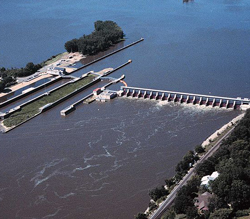 The House Transportation Committee made a long-awaited move Wednesday and introduced a water resources development bill that adds an extra R to WRDA and provides some hope that improvements will finally be made to outdated locks and dams on waterways that move crops to export markets.
According to the committee, the Water Resources Reform and Development Act of 2013 (WRRDA) “cuts federal red tape and bureaucracy, streamlines the infrastructure project delivery process, promotes fiscal responsibility, and strengthens our water transportation networks to promote America’s competitiveness, prosperity, and economic growth.”
 The issue was a major topic of discussion at the Farm Progress Show where committee member Congressman Rodney Davis (R-IL) told farmers he expected the bill to be introduced this month.
“We’ve got to have better policies in place, because even the Corps of Engineers says with full funding right now it would take them 40 years to complete the upgrades to the lock and dam system on the Mississippi,” said Davis. “That’s unacceptable.”
The committee’s bill includes a provision authored by Davis and Rep. Cheri Bustos (D-IL) to improve waterway infrastructure though public-private partnerships “with one goal in mind, to speed up the process that will allow us to have greater locks and dams,” he said. Interview with Rep. Rodney Davis
National Corn Growers Association First Vice President Martin Barbre of Illinois hopes members of Congress understand how critical the situation is before it’s too late. “One of these days, there’s not going to be any salt going to Chicago in the middle of winter because the locks and dams are broke down, then they’ll realize what the corn growers have been fighting all this time,” Barbre said during an interview at Farm Progress Show.
The Davis-Bustos language authorizes the creation of a pilot program that would allow the Army Corps of Engineers to identify 15 water resources development projects eligible to be financed through public-private partnerships. Similar legislation was included in the Senate version of WRDA which passed in May.
Posted By Cindy May 20, 2013
There was lots of activity of interest to corn farmers last week - both on The Hill and in the field.
 I caught up with National Corn Growers Association Chairman Garry Niemeyer of Auburn, Illinois on Friday as he was busy playing catch up on planting progress. “We are probably about a fourth done with planting corn,” Garry said. “We normally are finished planting corn by the middle of April.” He added that since June 1 is the cutoff date for crop insurance they still have quite a bit of time to get a crop in and “everybody here is feverishly working.” While it has been the longest cold, wet spring that he can remember, Garry says it has really warmed up now in the Midwest and he thinks the corn will probably “come flying out of the ground” now.
Up on Capitol Hill last week, as so many like Garry were busy in the field, two pieces of legislation very important to farmers made significant and long-awaited progress. One was the passage of a new five year farm bill through both the House and Senate Agriculture committees. However, Garry is quick to note that we are still no further along on a new bill than last year at this point. “We never got a House bill to the floor (last year),” Garry noted. “I’m going to hope that the House finishes up, then they go to conference and we get a reasonable bill which will help all American farmers.”
Meanwhile, the Senate finally passed the Water Resources Development Act (WRDA) last week, paving the way for upgrades to the inland waterways system important for farmers. “It’s been a long time, since 2007, since we’ve had a WRDA bill and back before 2000 they used to have a WRDA bill every other year,” Garry says. “Now we just need the funding to get these project moving forward.”
Of specific interest to corn farmers, the bill contains provisions to remove the over-budget and long-delayed Olmsted lock and dam project from the Inland Waterways Trust Fund (IWTF), the remainder of the cost to be paid 100 percent by general treasury revenue and not cost-shared 50-50 through the IWTF. This action will free up around $750 million to the IWTF to complete critical priority navigation projects. An increase in the threshold for major rehabilitation, from the current $14 million to $20 million, was approved.
The bill now goes to the House for approval and Garry says they are encouraging farmers to call their representatives in Congress to tell them how important this legislation is to them.
Listen to Garry’s comments here: NCGA Chairman Garry Niemeyer
Posted By Mark August 13, 2010
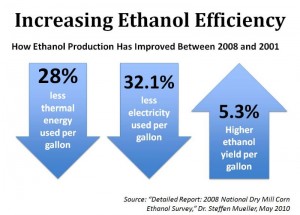 We are officially in the dog days of summer and as such many people are vacationing and that often means lots of driving and time with family.
With all the exposure to gas stations you may have noticed the word ethanol on pumps. It is pretty much everywhere these days as a 10% blend in gasoline and it is increasingly showing up in E85 formulations for flexible fuel vehicles or FFVs.
In fact, GM recently announced their continued commitment to E85 ethanol as “our best near-term solution. In fact, last month, we announced that we’re increasing annual production of Flex Fuel Vehicles (FFV) to more than 850,000 – that’s a 55 percent increase from the 2006 volumes,” said Candance Wheeler, a Gm Technical Fellow.
GM’s 2010 lineup represents the most FFV models on the market, providing drivers with multiple options to fuel their vehicles – E85 ethanol, petroleum, or a combination of the two. And with many new stations opening up, especially in the south and south central regions, it’s becoming easier find a place to fill up.
The latest development is something called a “Blender Pump,” but I like to call it a consumer pump because it allows you to choose what gas or ethanol mixture you want; unleaded gasoline, or 10%, 20%, 30% or 85% ethanol. If you have an FFV you can pick whichever one is the best bargain or whichever blend works best in your car.
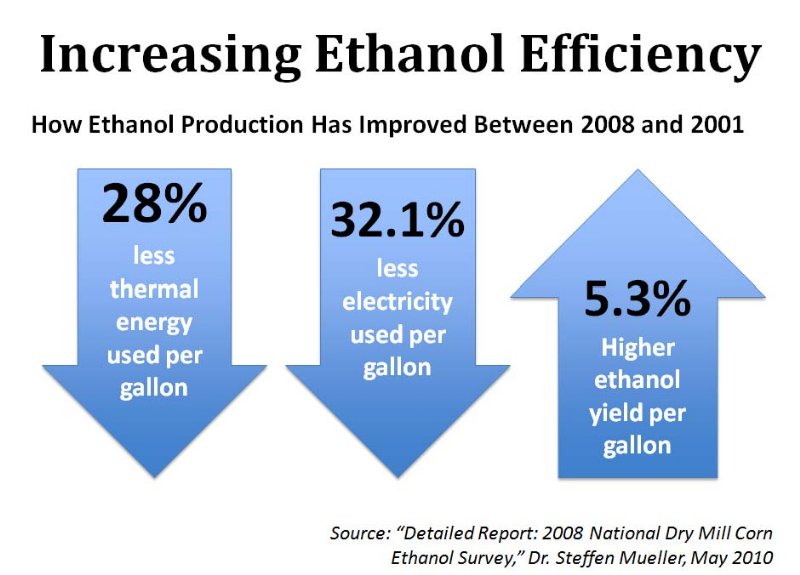
Despite all for proven benefits of ethanol some detractors continue to spread misinformation regarding ethanol fuel. As the attached charts show, ethanol is a great fuel and an even better idea if you believe we should rely more on farmers and less on imported oil from hostile nations.
Posted By Cindy June 7, 2010
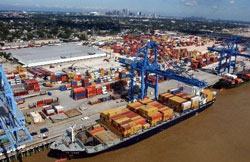 As the battle to contain the oil spill in the Gulf of Mexico are now likely to stretch into the fall, concerns are being raised that the situation could delay grain exports, according to Iowa State University grain markets specialist Chad Hart.
“If the oil slick got into what is called the Southwest Passage – which is a canal that goes from New Orleans out to the Gulf of Mexico – we would be looking at severe delays in getting our corn and soybeans shipped overseas,” said Hart.
Ships can sail through the oily water, but would need to be cleaned when they enter port. “When a ship comes into port, it would have to be cleaned if it went through the oil slick,” said Hart. “And then when it goes to their destination, it would have to be cleaned again when it arrives.” The result would be much slower movement of grain out of the Midwest to foreign markets.
There are some reports coming out of the Port of New Orleans that indicate vessels that would normally dock in New Orleans are diverting to other Gulf Coast ports, but authorities say only one of 600 ships that have come in since the spill had to be cleaned.
The oil spill has been moving mainly to the east, so there has been little impact on the shipping lanes, which lay to the west of the slick. But Hart says there could be an impact on grain prices if the slick does start to affect the shipping lanes.
Posted By Mark February 26, 2010
Our extensive water transportation system in the United States may very well be one of our greatest national economic and strategic assets. It is definitely our most unappreciated means of moving goods because the vast majority of the population doesn’t see river transport in action, smell it, or risk getting run over by it.
That’s also the downside. People will support road projects all day because of our personal engagement with the asphalt and concrete, but ignore our most efficient and environmentally safe means of moving critical goods from coal to corn to construction materials.
So it is concerning that a critical part of our nation’s transportation infrastructure, the locks and dams along the Illinois River and the Upper Mississippi River, are deteriorating and falling behind technologically after 80 years of stalwart contributions.
Granted, this oversight may be understandable given the public and government’s focus on political issues from war to health care and economic issues that don’t need any explanation, but the consequence for this lack of vision may carry a big price tag in years ahead.
The country’s inland navigation system plays a critical role in the nation’s economy, moving more than a billion tons of domestic commerce valued at more than $300 billion per year. More than one billion bushels of grain (about 60 percent of all grain exports) move to export markets via the inland waterways each year.
Growing agricultural productivity in the U.S. and growing populations and buying power overseas provide some clues to the critical importance of addressing this issue. Population is expected to grow by 2.5 billion more people by 2050 to more than 9 billion people and many of those hungry eyes will be looking to the U.S. to keep their pantries and their stomachs full.
There are also significant environmental benefits to the inland waterway system. The backwaters created by the lock and dam system support more than 40 percent of the migratory water fowl and fish breeding grounds and are home to more than 500 miles of wildlife refuge. In addition, more than $1 billion are generated each year in recreational use – fishing, hunting and tourism.
So if the opportunity arise to tell your local, state or federal elected officials they need to get active now on updating our water transportation system it will be time well spent.
Posted By Mark August 5, 2009
 Just saw one of best arguments ever made against our continuing dependence on petroleum and better yet, it came from a global oil giant, Occidental Petroleum.
The commercial, now posted on You Tube, shows a gentleman and his dog reacting as many of the products in their home that contain petroleum disappear. Everything from the TV remote, to his easy chair and eventually the shingles on his home mysteriously go “poof” as evidence of how much we depend on petroleum.
I am sure some marketing/ad agency guru persuaded Occidental this cute concept was a good idea. However, in the decade of $4 gasoline not everyone views the commercial that way. For those concerned about our reliance on imported oil for more than 60% of our needs, this looks somewhat like a clarion call. All I could think while watching this is maybe we can still avoid the images portrayed in the spot by taking aggressive steps to reduce this petro dependence.
Maybe they didn’t get the memo that virtually everything we make from petroleum can be made from agricultural products like corn. Carpeting, ethanol, film and plastic resins are being made today. Combine this knowledge with the growing production capacity of corn producers and I think Occidental may have let the genie out of the bottle.
Life Without Oil sounds like a goal to me.
Posted By Cindy November 9, 2007
Congress voted to override the presidential veto of the Water Resources Development Act, or WRDA, because it authorizes funding for water projects from coast to coast, but the centerpiece of repairing locks and dams on the Mississippi River was the main concern for corn growers.
“When it comes to this issue, nothing has been easy,” said NCGA President Ron Litterer. “After almost two decades of work by corn growers, millions of dollars spent on studies, seven years of waiting on the legislative process, a presidential veto and then a veto override by the U.S. Congress, we finally have achieved authorization to modernize seven locks on the Upper Mississippi River System. Once again, our grower members demonstrated their influence and commitment to the Water Resources Development Act by contacting their members of Congress and urging them to overturn the president’s veto.”
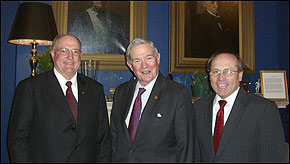 Litterer celebrated the victory this week with NCGA First Vice President Bob Dickey and Senator Kit Bond of Missouri who is credited with his perseverance in getting the legislation finally passed.
Missouri Corn Growers Association CEO Gary Marshall says, “No one deserves more credit for this bill becoming law than Senator Kit Bond. We owe him our sincere thanks for his vision and determination to see the locks and dams on the Mississippi and Illinois rivers upgraded.”
“These upgrades will spur economic growth for mid-America and will certainly go a long way towards improving access to world markets,” said Missouri Corn Growers President Mike Geske. “Our competitiveness in global trade has become much greater today due to the WRDA bill finally becoming law. We will now work with our Congressional delegation to see that funding is also approved.”
“Iowa’s corn growers should really celebrate this achievement,” said Warren Kemper, a grower from Louisa County and long-time advocate for improving the river’s infrastructure. “The ICGA has been lobbying for lock and dam improvements for more than a decade. WRDA is important to farmers who depend on the inland waterways, but it is also important to the whole economy of the upper Midwest.”
“It’s taken nearly two decades of work by corn growers and a consortium of other trade groups nationwide, as well as millions of dollars in studies, to finally authorize work to repair and modernize seven locks on the Upper Mississippi River System,” said Wisconsin Corn Growers Association President Tom Novak. “While we’re glad legislation finally passed, we still have a great deal of work to do to ensure the work it authorizes is properly funded.”
Even though President Bush vetoed WRDA citing the cost as the reason, the bill actually only authorizes the projects and opens the way to appropriate the funds needed to replace the locks. Once the money is appropriated it will still take more than 15 years to replace the 70-year-old locks that are falling apart.
Posted By Cindy November 7, 2007
The Senate is expected to follow the lead of the House Thursday and override the presidential veto of the Water Resources Development Act, better known as WRDA. The House vote on Tuesday was 361-54 with 18 members absent, well over the two-thirds needed for the override.
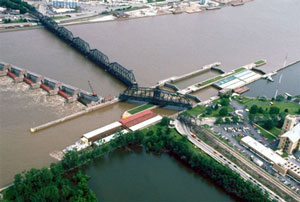 Late Wednesday, the Senate was debating the measure with most speaking in favor of the override. President Bush vetoed the $23 billion bill, which includes a variety of water-related projects around the nation, including the modernization of seven locks along the Upper Mississippi and Illinois River.
“This is great! We have worked so hard and so long to get improvements on the Upper Mississippi River System authorized,” said Ron Litterer, president of the National Corn Growers Association.
Litterer says the project to upgrade the lock system will improve delivery of crops to the global marketplace. More than half of all grain exports are shipped by way of inland waterways, accounting for $8.5 billion in exports.
The bill will also provide funding for environmental restoration, flood control, port modernization, irrigation and hurricane protection.
If the Senate does vote in favor of the veto override, as expected, it will be the first time that has happened during the Bush presidency. The Senate originally passed WRDA by an 81-12 margin.