Posted By Mark February 7, 2014
 It’s tax time again. You know that short window during the year when it’s ok to complain about being taxed. Given the number of people who remain unemployed it really is kind of bad form to complain the rest of the year.
So as you belly up to do your part to keep the skids of government greased here is a whopper of a tax tale to help you really get the bile out and make your complaining count. I am guessing that it will come as no shock to you that each year the average American pays more than 20 percent of their income in federal taxes. This does not include state and local taxes.
So this begs the question; shouldn’t an industry that makes $175,000 per minute pay at least that much? This is a real number reflecting the profits of the five largest oil companies. Together they earn more in one minute than 95 percent of Americans earn in a year.
However, Reuters news service estimates that Chevron, ConocoPhillips, and ExxonMobil pays effective federal tax rates of 19 percent, 18 percent, and 13 percent, respectively. Reuters noted that this is “a far cry from the 35 percent top corporate tax rate.” Likewise the tax bracket for the most successful Americans is 35%.
The petrol industry has prospered over the past decade, thanks to high oil and gasoline prices. The five largest companies — BP, Chevron, ConocoPhillips, ExxonMobil, and Shell — earned more than $1 trillion during this time. In the first nine months of 2013, these five companies realized a combined $71 billion in profits. Certainly, these companies can prosper without $2.4 billion in annual special tax breaks.
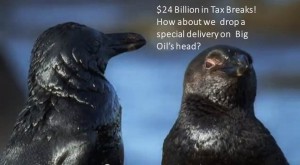
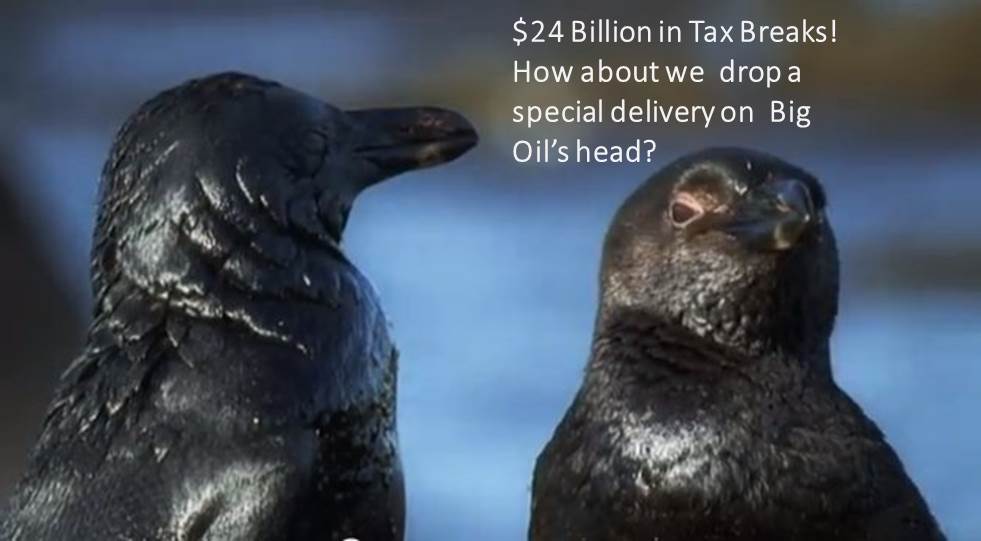
The Congressional Joint Committee on Taxation estimated that three tax preferences provide $24 billion per decade in annual benefits to these five companies. The “limitation on Section 199 deduction,” designed to encourage domestic manufacturing to remain on shore, costs the Treasury $14.4 billion per decade for these five companies. The foreign tax credit deduction saves the big three domestic oil companies $7.5 billion per decade. The “intangible drilling costs” deduction saved the five companies another $2 billion, according to the Wall Street Journal.
It also seems the oil and gas industry has been the largest beneficiary of federal financial support in the entire energy sector benefitting from nearly 60 percent of all federal energy support since 1950. Shouldn’t the lion’s share of these dollars be spent on new, alternative, renewable sources to make us less dependent on something as finite and as devastating to the environment as oil?
Big Oil will argue that these breaks are critical to job creation, but recent data from the Bureau of Labor Statistics shows oil industry employment is off 10 percent. This is not nearly as bleak as it sounds given that nearly half of the direct jobs touted by big oil are service station positions.
Simply put, it’s time to end special tax breaks for BP, Chevron, ConocoPhillips, ExxonMobil, and Shell.
Posted By Mark August 19, 2010
Is there a full moon out or what? In my normal course of scanning news, web sites and blogs for information I discovered a veritable trifecta of absurdity regarding petroleum the other day.
My favorite article had to be about a new study arguing that eliminating federal tax deductions for intangible drilling costs and for US oil and gas production expenses would hurt oil production growth and devastate future US natural gas development.
The Wood Mackenzie study was commissioned by none other than the American Petroleum Institute. (nod, nod, wink, wink). Aren’t these the same companies (foreign & domestic) who were raking it in hand over fist from 2003 to 2008 and making record profits?
Excuse me but when any single company’s sales outpace the domestic national product of 120 nations as Exxon-Mobil’s did in 2008 I find it hard not to be a little skeptical regarding the Woods Mackenzie Study.
We have seen repeatedly that domestic oil price shocks are a result of refining and distribution problems more than even supply. Mix that in with inadequate competition in the oil industry and an ample dose of bad energy policy and you get a real mess. Maybe this is why the petroleum giants have tried repeatedly to discredit the performance and viability of ethanol.
This might go a long way toward explaining why they have so energetically fought against “tax incentives for blending ethanol” that actually go the ethanol blender…once again oil. Forgoing short term gain for long term profit is not a new concept. It also would explain their reaction to the current effort to raise the amount of ethanol in a gallon of gasoline.
Increased ethanol demand cuts into petroleum’s profits and their ability to manipulate the market. The economic impact of being able to control a product we are addicted to from cradle to grave is heady and lucrative stuff. (more…)
Posted By Mark August 2, 2010
 A recent study attempted to make the case that if the U.S. government allowed the ethanol tax credit to expire it would have very few adverse consequences for the U.S. industry. The fact the study was funded by the Brazilian sugarcane ethanol industry was dutifully avoided.
Anti-ethanol folks, who have been receiving a lot of attention on this blog of late, made sure the study got plenty of media splash because it helped them further their own causes. Interesting they didn’t showcase the source of the funding for the study or point out how badly Brazil’s sugarcane ethanol industry lusts after access to the world’s largest ethanol market…the USA.
And in today’s budget conscious environment in Washington, DC their efforts are getting some traction. The direct cost of the ethanol incentives is being reviewed independently without any comparative assessment to savings in farm bill costs, how much we spend militarily on protecting our petroleum shipping lanes, or the economic fallout from depending on foreign oil. Federal tax revenue generated by the production and use of U.S. ethanol totaled more than $8 billion in 2009, $3 billion more than the value of the tax credit.
It is amazing how quickly some of our elected officials have forgotten the core rationale for putting the US ethanol tax credit in place. President Ronald Reagan, who was not exactly a political Dove, regularly noted it is in America’s best interest to reduce the world’s dependency on oil from unstable regions of the world.
That’s why Reagan and virtually every president since has asked domestic alternative energy producers like ethanol to step up. He also noted the expense related to America’s foreign oil addiction and how helpful bringing these energy jobs and the billions of dollars ($1 billion day) we send overseas could be for the U.S. economy.
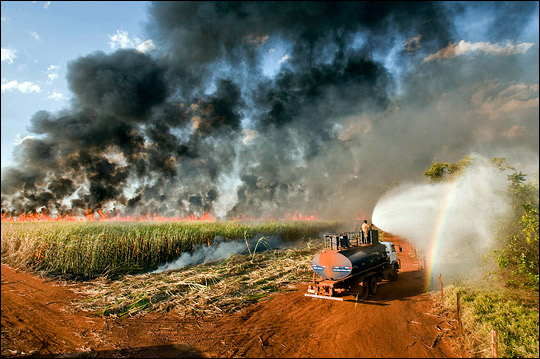
Despite this clarion call the aforementioned detractors, which mysteriously enough include some environmental groups, like to preach the benefits of sugarcane ethanol; sometimes called “slash-and burn ethanol.”(See attached photo). It’s even more amazing some U.S. regulatory agencies actually tout Brazilian ethanol as an “advanced biofuel over the American made corn product. In case you were wondering the photo shows a burning cane field in Brazil. The Sao Paulo area alone burns 8,000 sq miles of field producing incredible amounts of volatile compounds and particulates.
To make harvesting easier, which reduces manual labor costs, sugarcane fields are burned prior to harvest to remove the plants’ leaves. Considering the near slave labor conditions in some cane fields I guess this burning might seem a gift for the machete wielding masses, despite the obvious environmental costs of the massive burning.
If critics are truly concerned about our fuel needs and specific environmental and economic consequences consider the following:
Data from the Brazilian sugar organizations clearly shows they are planning, by 2020, to export 63% more sugar and export 336% more ethanol – all at the expense of increasing the land area required for sugarcane by 78%. Corn based ethanol is being provided with increased corn yields on the same acreage and using modern production processes throughout the production chain.
Sugarcane ethanol provides primarily ethanol, with some electircal cogeneration. Corn based ethanol provides ethanol, high protein feed for livestock, corn oil, and even captured CO2 from the fermentation process to carbonate soft drinks.
Sugarcane ethanol provides jobs that don’t meet subsistence level incomes, while jobs in the ethanol production chain are highly skilled jobs that provide long term employment and taxable income for local schools etc…
And the next time you want to get on a soapbox promoting sugarcane ethanol consider the following items below which are being ignored to make Brazilian product look better than it is:
- Ignoring direct and indirect emissions from crop residues;
- Use of inappropriately low fertilizer rates;
- Failure to account for energy inputs for dehydration of hydrous ethanol;
- Failure to accurately assess transport of ethanol from Brazil to U.S.
- Failure to assess actual cane harvesting practices and processing in Brazil
At the end of the day if the U.S. ends up importing more ethanol, then we will once again lose a domestic growth industry, export American jobs, and become dependent on foreign energy producers.
Posted By Mark July 29, 2010
 Dear New York Times…Your editorial today regarding corn-based ethanol is superficial, either uninformed or malicious, and a disservice to the citizens of this nation looking for real energy solutions we can implement today.
Before addressing some of the onerous points in your piece, please take a look at the attached photo. This is not from the BP spill in the Gulf but rather the latest incident in Michigan which has dumped a million gallons of oil into a river and is now 80 miles from polluting Lake Michigan. Oil is and always has been a loaded gun from an environmental perspective. From leaking tanks at service stations to oil tankers grounded on coral reefs in storms. No more explanation needed on this one.
However, perhaps the biggest point you fail to address is wind, coal, and geothermal don’t make your car go. Natural gas can be used as an automotive fuel but it too is not renewable and has other issues I won’t go into here today. Solar….I’ll race you with my bicycle.
Will ethanol be made from other sources some day? Undoubtedly. Other biomass sources show real potential and will come with the proper research and development, but corn-based technology and infrastructure is the very launching platform for this effort. Yet opponents would have us build our domestic energy house without a foundation.
Ethanol…dubious environmental benefit? Line up the hundreds of studies regarding ethanol, look at the funding sources and consider what is left. What you will find is a long trail of reputable scientists and institutions public, private and governmental that clearly shows the environmental benefits of ethanol.
When compared to petroleum especially, ethanol is a rock star in regard to cleaning the air, maintaining water quality, and soil management. On the oil side think tar sands.
Your reference to the land use issue is also comical. Incredible productivity on our existing corn acres is easily supplying the growing ethanol industry while also meeting the needs of other markets. And yield growth is accelerating.
And finally, I think we must aggressively pursue all forms of renewable, domestic energy given the finite nature of petroleum and do so in good conscience because of the legacy we stand to leave future generations. To suggest we put our entire energy investment in “maybe someday” sources while ignoring a viable and tested source like ethanol is shortsighted at best.
Posted By Mark July 27, 2010
 My brother-in-law recently asked me why ethanol had a great reputation for two decades and suddenly seems to be getting pounded constantly, especially in editorial/opinion pages by the media.
He doesn’t have a farming background and isn’t invested in the ethanol industry so he is a neutral and somewhat uninformed observer. He is also one of the busiest guys I know so for him to notice it means the anti-ethanol crowd are now officially pervasive. Apparently, it’s not just me feeling paranoid.
The conversation came back to me in a hurry this week with the latest “ethanol is evil” Tsunami rolling across the country once again. It started with the Wall Street Journal (No link here because you have to pay for this tripe) and the Washington Post and worked its way across the country hitting the Chicago Tribune and Des Moines Register yesterday and likely making its way for the West Coast like some cheap traveling circus.
And like the aforementioned Circus the anti-ethanol gang leave a trail behind much like Barnum and Bailey’s elephants only there is no guy with a shovel and bucket cleaning up in their wake. They leave their load of “misinformation” to fester in the road in full knowledge that most people are also too busy to check the veracity of their propaganda.
The public lynching of ethanol began with the bogus food vs. fuel charade in 2008 and since then has continued to resurface over and over again in several different guises that get trotted out and recycled whenever opportunity presents itself.
Several things remain consistent as the attacks continue. The noxious cocktail they serve up is made with equal parts of the best bad science money can buy and poor logic. And the olive on the toothpick seems to be just plain old avarice.
That’s greed, materialism, or covetousness with a Capital “C.” The people fanning the fires of these attacks have rationale and motivation that are simple if not transparent. They are the folks that want the cheapest corn possible because it boosts their profits; want ethanol to be made from another source; or want ethanol crippled forever because the market share just got too big.
So, for the next couple of days come back here and you will get a sneak peak each day of some of these players and the Machiavellian games they play and fund all to snuff out the only real competition that imported petroleum faces in the marketplace today…ethanol.
Posted By Mark June 11, 2010

Is ethanol our energy savior or is it the biggest scam of the decade? Is it just plain smarter than drilling two miles down in the Gulf of Mexico or do we just have our heads stuck in the tar sands hoping it will all just go away? Michael Vaughan, who hosts a Canadian TV show called Car/Business tackles this question in a thoughtful manner in the latest issue of The Globe & Mail.
In true human fashion people are looking for silver bullet solutions to this environmental disaster, for black and white answers, when most big issues tend to be very grey indeed. Vaughan does provide an interesting perspective from someone outside our borders and offers lots of insights:
- Maybe more people will come to understand that anything made from oil can be made from crops and biomass.
- Close to half the world’s oil production and 25 per cent of U.S. production is expected to come from deep-water wells by the end of the decade.
- To get to The Green Highway we need technology that is coming from the auto industry but also a greater reliance on renewable energy
- After meeting all of the needs for corn in North America there was still 1.9 billion bushels of corn exported, half of it as foreign aid.
Corn Growers as an organization has been relatively low key on this issue because of the loss of life and the serious environmental implications. But how long can the public at large sit on their hands and wait for divine intervention on the energy front?
Personally I believe we have an obligation as Americans, as the world’s largest energy users, to work as aggressively as possible toward greener, long term answers. If someone wants to say this opinion is opportunistic, then so be it. (more…)
Posted By Mark November 17, 2009
 Apparently, last week’s International Energy Agency (IEA) numbers regarding future oil supplies were fudged to protect the innocent or at least our frail economic recovery. According to a whistleblower who whispered in the ear of The Guardian, the world is much closer to running out of oil that we think.
So, what is to be gained or lost by such skullduggery? Stockbrokers, bankers and oil investors jumping out of windows…sure, but what is the downside? (Insert sarcasm here).
The comments in the UK’s respected Guardian stated that the IEA has inflated its 2009 report of oil reserves for fear that the truth would shock world markets into a reactionary panic. IEA is alleged to have put its role as an industry watchdog in the kennel for the time being to fend off a potential buying panic…even at the risk of being exposed for overplaying supplies and chances for finding increased reserves.
On face value this might seem to be based on at least a modicum of twisted logic, but what are the ramifications for world governments who govern, plan and even invest based on IEA’s data? Consider that they also develop their own energy policies based on such essential information.
According to the Guardian’s high-level IEA source, estimates of global oil production growing from its current level of 83 million barrels per day to 105 million barrels per day are as bogus as the Tooth Fairy. The source said many IEA officials believe even 90 million barrels per day is unreachable, but the agency will not lower its forecast because it fears panic could spread through financial markets.
If we have indeed entered the “Peak Oil Zone” (that strange and unfamiliar place where we actually feel the pressure to get real about “energy policy” not oil policy) then it is time to fess up like an alcoholic at an AA meeting. “Hi my name is Joe Consumer and I have a petroleum problem.” (more…)
Posted By Cindy October 1, 2009
A new climate change bill was introduced this week - but is it any better than the first one?
Sens. Barbara Boxer (D-Calif.) and John Kerry (D-Mass.) debuted the “Clean Energy Jobs and American Power Act,” an 821-page bill designed to “create clean energy jobs, reduce pollution, and protect American security by enhancing domestic energy production and combating global climate change,” as well as creating millions of green energy jobs. Part of that includes reducing carbon emissions by 20 percent by the year 2020 and 80 percent by 2050 compared to 2005 levels.
“This is a security bill that puts Americans back in charge of our energy future and makes it clear that we will combat global climate change with American ingenuity. It is our country’s defense against the harms of pollution and the security risks of global climate change,” said Kerry. “Our health, our security, our economy, our environment, all demand we reinvent the way America uses energy. Our addiction to foreign oil hurts our economy, helps our enemies and risks our security.”
Senator Boxer said, “We know clean energy is the ticket to strong, stable economic growth — it’s right here in front of us, in the ingenuity of our workers and the vision of our entrepreneurs. We must seize this opportunity, or others will move ahead.”
However, reaction to the measure has been mixed. U.S. Senator Saxby Chambliss (R-Ga.), Ranking Republican Member of the Senate Agriculture Committee, is not a fan.
 “As I have stated many times before, I want to support legislation that addresses climate change and provides a more secure energy future for America. Unfortunately, the legislation introduced today by Senators Boxer and Kerry follows the House-passed bill down the path of higher energy costs, job losses and economic pain for no benefit. Further, it would only hurt farmers, ranchers and forest landowners and provide them no opportunity to recoup the higher costs they will pay for energy and the other inputs necessary to work the land. I cannot support this bill.”
So, we’ll see where this one goes.
Posted By Mark September 14, 2009
 An American Petroleum Institute publication out this week contains two unrelated but ironically intertwined stories. The first – an opinion piece from the Washington Post casts a stone at the U.S. Department of Energy, taking them to task for funding programs to reduce our reliance on petroleum and efforts to speed the transformation of the nation’s vehicle fleet to alternative sources.
The second article quotes the investment bank Morgan Stanley which has raised its forecast of U.S. crude oil price to $105 (U.S.) a barrel in 2012 from $95 due to tightening spare capacity and growing world demand.
Through its Clean Cities program, the Energy Department will use $300 million in economic stimulus money for “petroleum reduction projects.” According to the agency, the funded programs will “speed the transformation of the nation’s vehicle fleet” by putting 9,000 alternative fuel vehicles on the road and creating 542 refueling stations for them. (more…)
Posted By Ken June 10, 2008
The National Center for Public Policy Research, a Washington, D.C., “think tank,” has released the results of a poll it commissioned surveying public attitudes about the renewable fuels standard. The press release headline states “Farm-Belt Voters Favor Eliminating or Scaling Back Corn Ethanol Mandate, New Poll Finds.”
So, haw many “Farm-Belt Voters” were surveyed for this poll? 500? 1,000?
How about … 40. Of the 802 voters surveyed, only 5 percent were what the pollsters considered farm belters.
But what is truly ridiculous here is the transparency of the bias. Question Three of the poll gives a brief version of boths sides of the issue. But notice how the bias is toward one side:
“Supporters of this corn ethanol mandate say that the law promotes America’s energy security, reduces greenhouse gas emissions, and provides financial benefits for farmers and agricultural businesses.”
“Opponents of this corn ethanol mandate say that ethanol production is increasing food prices, produces more net greenhouse gas emissions than conventional gasoline, and contributes to world hunger by converting food to fuel, while doing little to promote energy security. It has been estimated converting the entire U.S. corn crop to ethanol would reduce gasoline consumption by only a few percentage points.”
And then Question Four adds information about the disputed land use research:
“Two new studies, one from Princeton University and the other from the University of Minnesota in cooperation with the Nature Conservancy, found that ethanol contributes more greenhouse gases than conventional gasoline to the atmosphere, while expanded ethanol production encourages habitat destruction.
“Now knowing this, do you believe the ethanol mandate should be…”
No attempt whatsover is made to offer an opposing viewpoint.
Well, it is a political season, and the pollsters are based in Washington, so maybe this survey is just one example of what we have to look forward to in the months ahead. But it’s a shame they stoop to this and cannot rely solely on arguing the facts.





 It’s tax time again. You know that short window during the year when it’s ok to complain about being taxed. Given the number of people who remain unemployed it really is kind of bad form to complain the rest of the year.